
Calf Hutch
Qingzhou Baimu Machinery Co., Ltd.
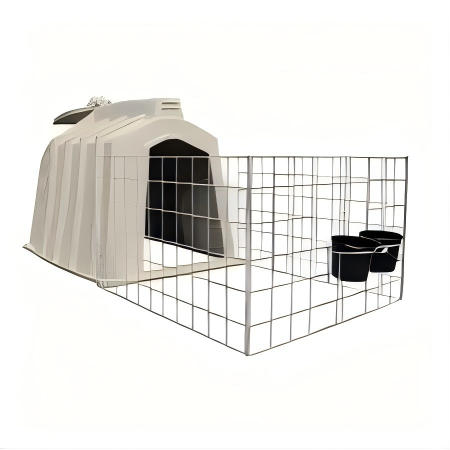
Add Your Tooltip Text Here
Calf Hutch Introduction
The calf hutch provides newborn calves with a private, clean, and insulated environment—significantly reducing diarrhea and respiratory diseases. It’s a standard tool in modern calf management programs.
1. Material
- Main body: Made of food-grade HDPE (rotomolded) or high-quality fiberglass (FRP);
- Features: Thermal insulation, moisture-resistant, corrosion-proof, non-toxic, and easy to clean/disinfect;
- Some models have anti-slip floors or removable bedding trays.
2. Available Types
- By capacity: Single-calf (standard), twin-calf (less common);
- By design: Fully enclosed or semi-open (with ventilation windows);
- Suitable for: Calves from birth to 8–10 weeks old.
3. Key Specifications
- Service life: 5–10 years (UV and weather resistant);
- Temperature resistance: -40°C to +70°C;
- Ventilation: Front-and-rear airflow vents to reduce ammonia buildup;
- Meets animal welfare standards—minimizes disease transmission.
4. Typical Dimensions
- External size (L×W×H): approx. 1400 mm × 800 mm × 1100 mm;
- Interior height: ≥900 mm;
- Front door opening: ~500 mm wide × 600 mm high (for easy access and care);
- Weight: 15–25 kg (easy to move).
5. Installation
No complex installation required. Place the hutch on a dry, level, well-drained area (e.g., sand, gravel, or concrete), ideally oriented away from prevailing winter winds. Line the interior with clean straw or bedding. The front door can be fixed open or left free. Clean and disinfect regularly to maintain hygiene.