
Egg-laying chicken cages
Qingzhou Baimu Machinery Co., Ltd.
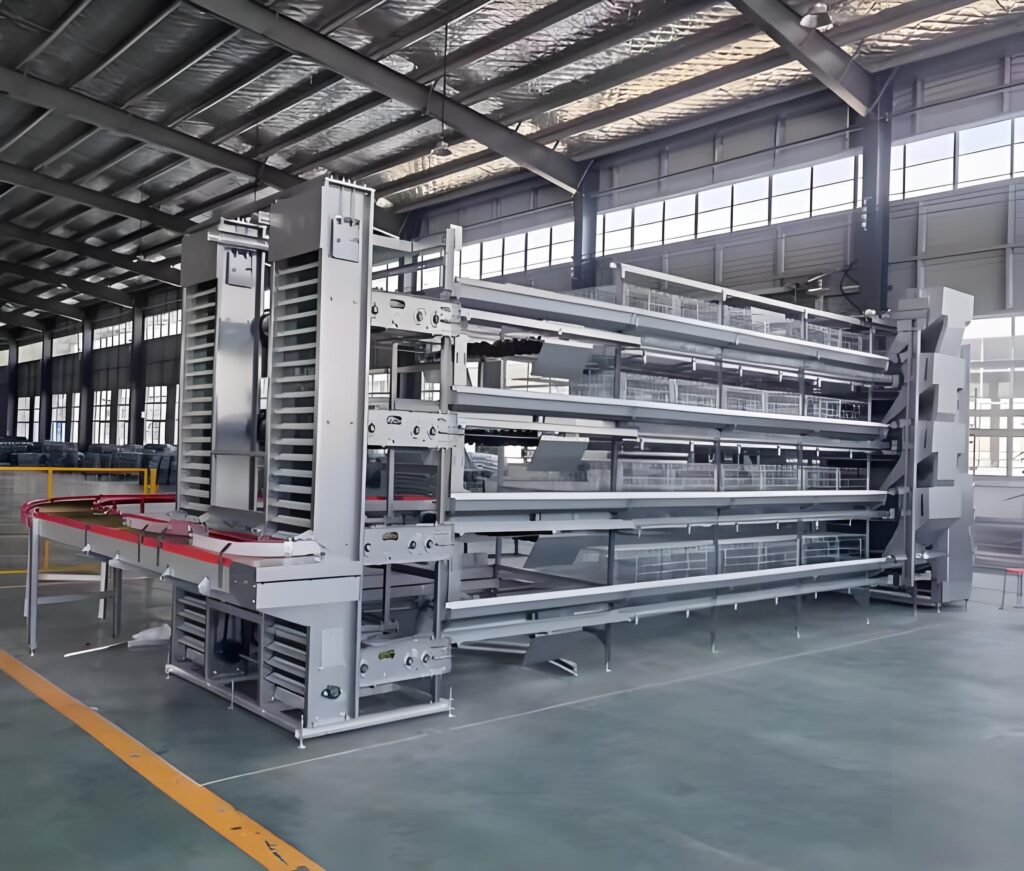
Introduction to Egg-Laying Chicken Coops
This equipment significantly reduces manual labor for egg collection, improves egg cleanliness, and boosts efficiency—making it a standard component in modern layer farms.
Material
The cage body is mainly made of hot-dip galvanized low-carbon steel wire, which is corrosion-resistant and rust-proof, and has a long service life. The bottom net is in a wavy structure, which prevents chickens’ feet from getting injured and facilitates the rolling out of eggs. The side nets, partition nets and the front door are all welded with high-strength steel wire, which are sturdy and durable. The connecting parts are mostly made of stainless steel or engineering plastics, and they do not age easily.
Specification types
(1) According to the number of layers: Commonly seen are three-layer, four-layer and five-layer cages, with more layers resulting in higher space utilization rate;
(2) According to the type of chickens: Suitable for light-weight egg-laying chickens (such as Hainan, Roman) or medium-weight egg-laying chickens, with slightly different cage sizes. Main parameters
Specification
Each layer of egg-laying hens occupies an area of approximately 0.045–0.06 square meters; the net height inside the cage is about 400–450 millimeters; the slope of the bottom net is 5°–8°, ensuring that the eggs roll automatically into the egg collection trough; the entire set of cage equipment can be used for 10 years or more under normal conditions.
Common dimensions
The size of each cage compartment is usually: length 450–500 millimeters × width 400–450 millimeters × height around 420 millimeters. It can accommodate 3–5 laying hens. The length of the entire set of cages is usually 1800 millimeters or 2000 millimeters, and the width is approximately 600–700 millimeters (including walkway supports). The total height of a four-tier cage is about 2200–2400 millimeters.
Installation method
Before installation, the ground must be level and hardened. First, fix the upright posts and crossbars, then install the bottom net, side nets, front door and egg collection trough in sequence. The cage modules are connected by snap fasteners or bolts. Note that the bottom net must be tilted towards the egg collection direction, aligned front and back, to ensure that the eggs roll out smoothly. The drinking line, feeding trough and manure removal system can be installed simultaneously.